

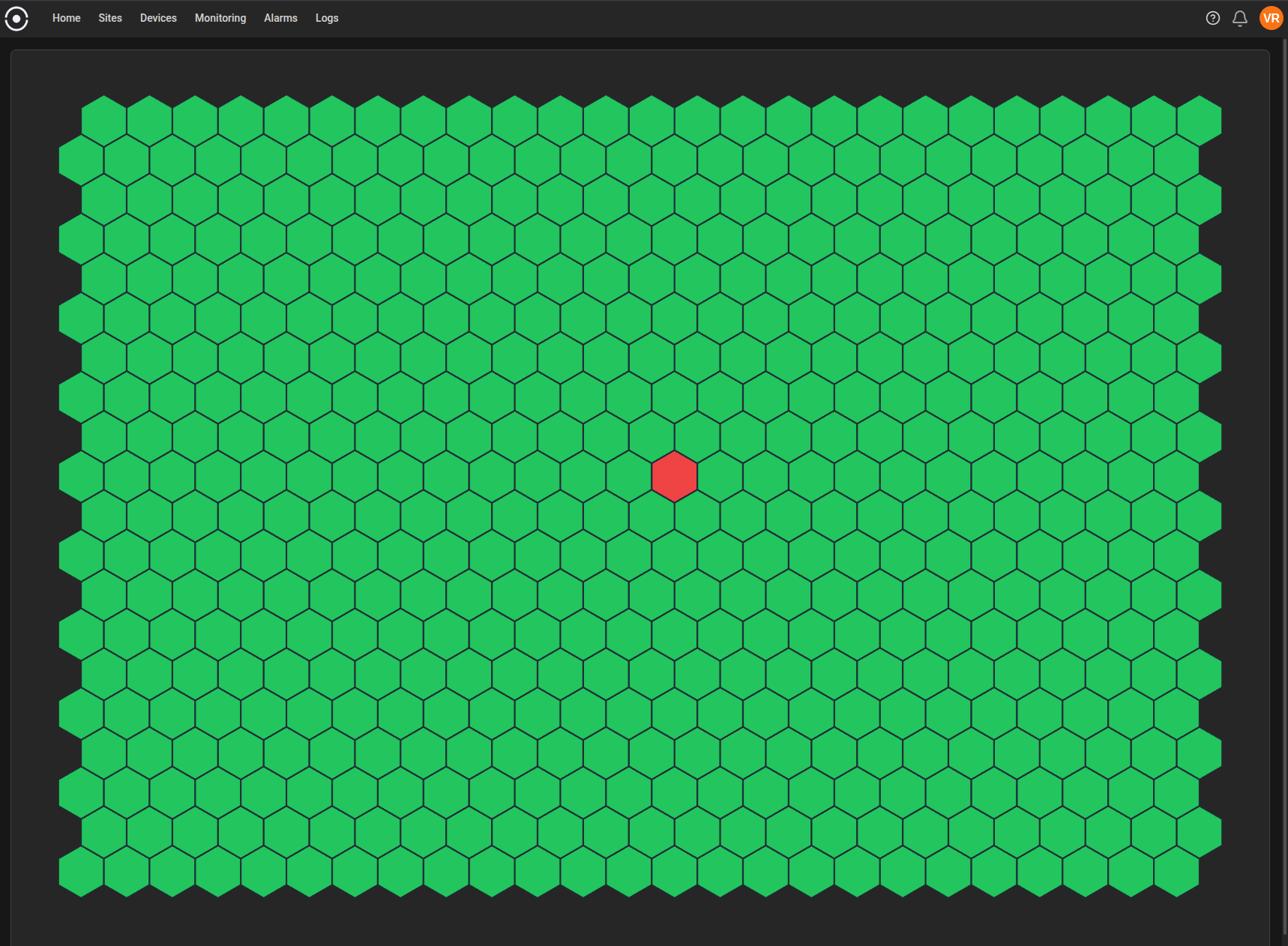
Automation is the engine of modern productivity. Robotic fleets in warehouses, manufacturing plants, and agricultural fields are now core components of operational strategy—no longer novelties, but necessities.
Yet beneath this promise lies a critical vulnerability: unplanned downtime.
The Scale of the Problem
This isn't a minor technical hiccup. It's a $1.4 trillion annual drain on the world's largest companies—equivalent to 11% of their collective revenues.
The Real Cost for Robotics Teams
But for robotics teams, the true cost isn't just a number on a balance sheet:
- 🚨 The panic of a 2 AM pager alert
- 😤 Skilled engineers turned into "digital janitors"
- ⛓️ The complex web of operational paralysis from one silent failure
The Domino Effect: Anatomy of a Fleet Failure
In a highly interconnected system, the failure of a single unit is rarely isolated. It's the first domino in a chain reaction.
The Scenario
Imagine a bustling logistics warehouse:
- Hundreds of Autonomous Mobile Robots (AMRs) weaving through aisles
- Complex fleet manager orchestrating every move
- Everything running smoothly... until it isn't
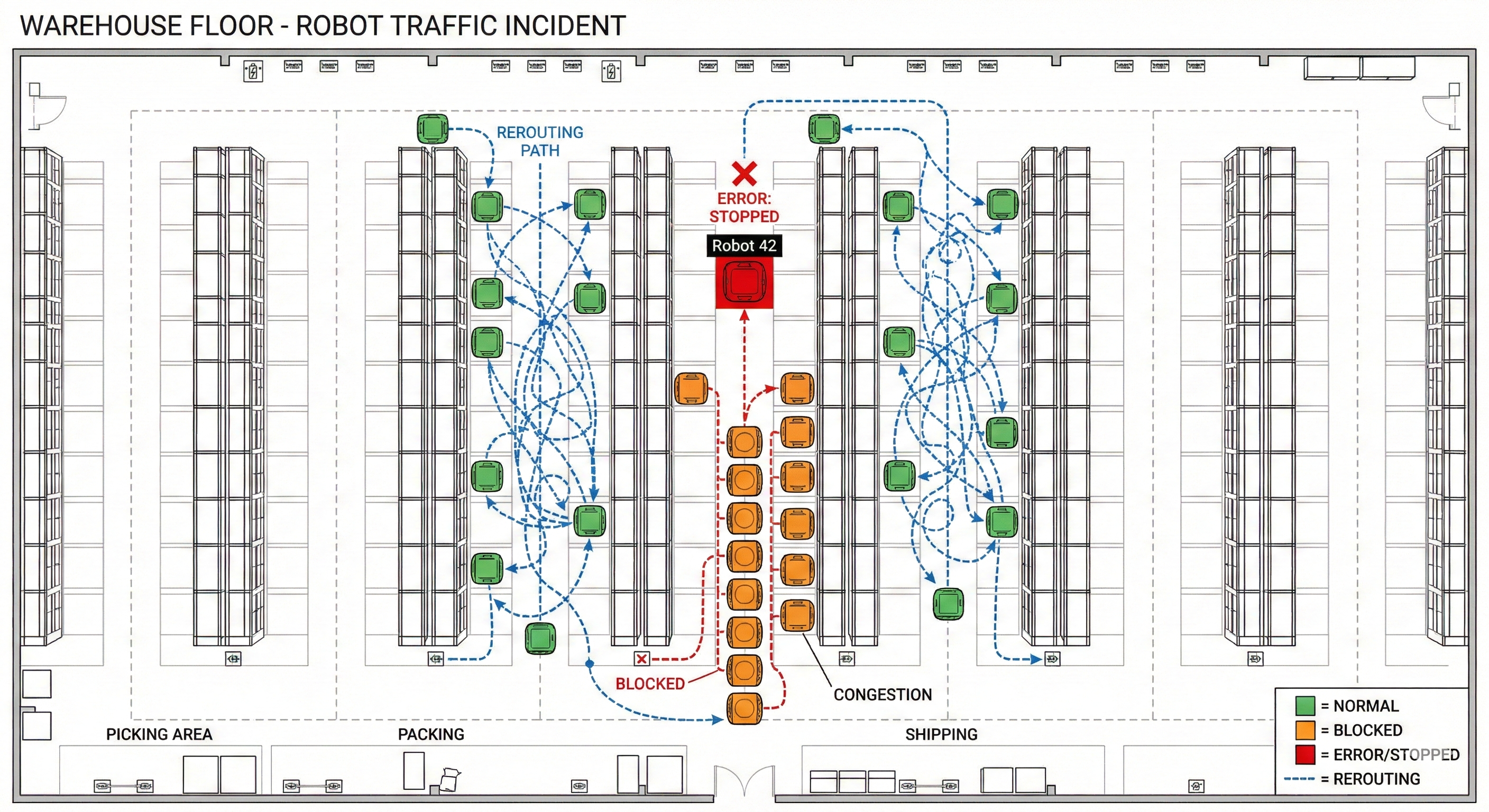
Suddenly, Robot 42 suffers a critical software error—a ROS node crash or sensor timeout—and freezes in the middle of Aisle 4.
The Cascade Begins
Immediate: Robot 42 is a 500lb paperweight blocking traffic.
But the secondary effects are where the chaos begins:
1. The Physical Traffic Jam: Dozens of AMRs following Robot 42 are forced to halt. The congestion spills out of the aisle, blocking intersections.
2. The Logical Gridlock: Many fleet managers use "time-window routing," where robots reserve space in the future. Even though Robot 42 is stuck, its "ghost" might still hold reservations for the next 10 minutes of pathing. Other robots—perfectly healthy ones on the other side of the facility—stop and wait for a ghost to pass.
3. The Throughput Collapse: Pick stations starve for inventory. Packers go idle. The entire facility's throughput collapses, not because the system failed, but because one unhandled exception cascaded through the logic of the fleet.
The Technical Gremlins Under the Hood
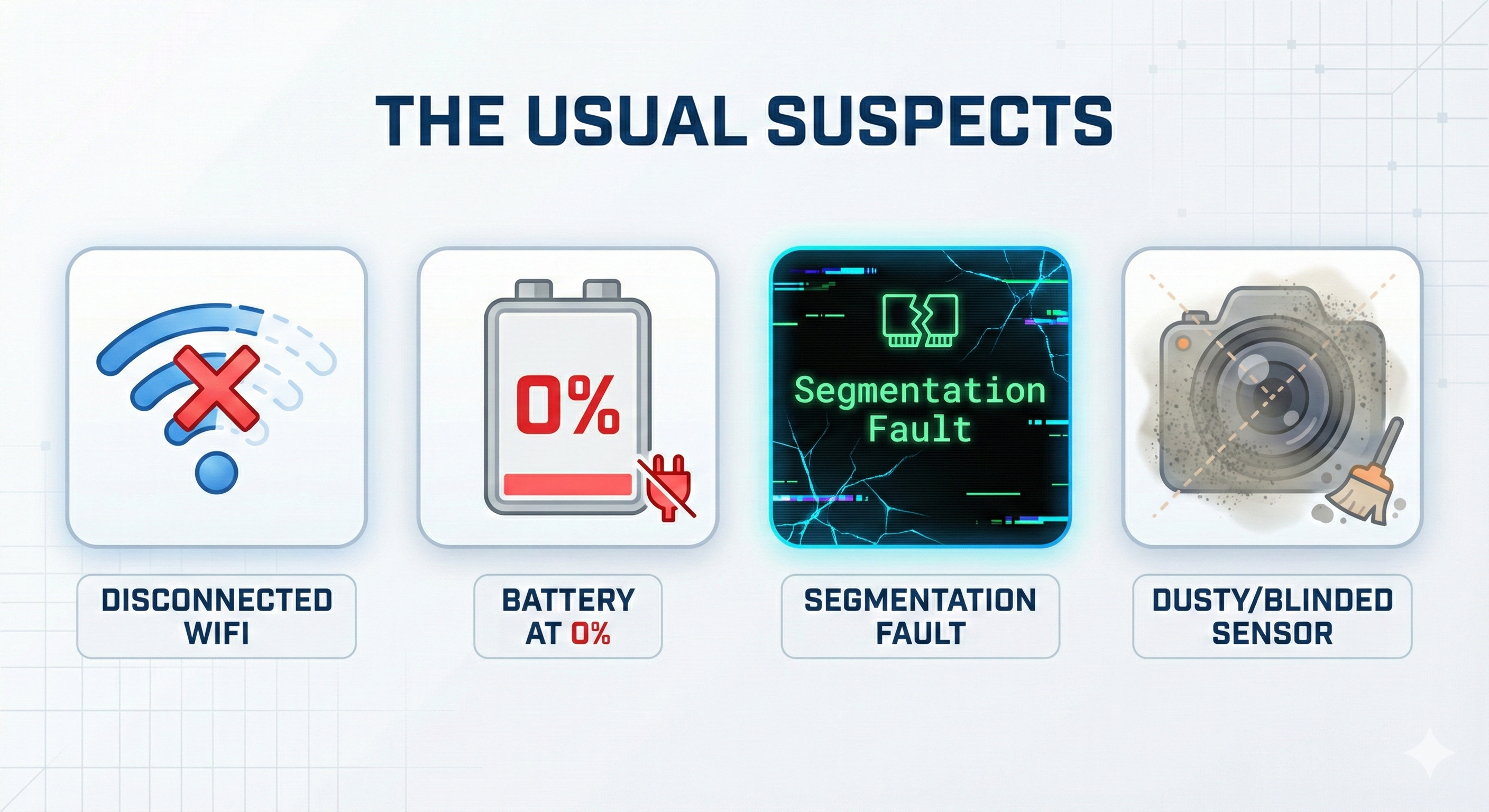
To solve downtime, we have to look "under the hood." Failures in robotics are rarely simple. They are usually a confluence of subtle issues across software, hardware, and the chaotic environment of the real world.
1. The ROS Node Crash
The modular beauty of the Robot Operating System (ROS) is also a liability. If a critical navigation node crashes but the motor controller keeps running, you end up with a "zombie robot"—moving but brainless. These states are notoriously hard to detect with simple "heartbeat" pings.
2. Configuration Drift
In a fleet of 500 robots, are you sure every single one is running the exact same version of the firmware? "Configuration drift" occurs when subtle differences in library versions or parameter settings creep in. It leads to the classic nightmare: "It works on my machine, but fails on Robot #105."
3. The Sim-to-Real Gap
Algorithms that perform flawlessly in a clean simulation often choke on the messy physics of the real world. A sun glare blinding a LiDAR, a slippery patch of oil, or a slightly skewed pallet can trigger edge cases that no simulation predicted.
The Downtime Iceberg: The Costs You Don't See
When we calculate the cost of these events, most teams look at the tip of the iceberg: Lost Production. "We were down for an hour, we make 100 widgets an hour, each widget is $5."
But the massive, submerged mass of hidden costs is what actually kills profitability.
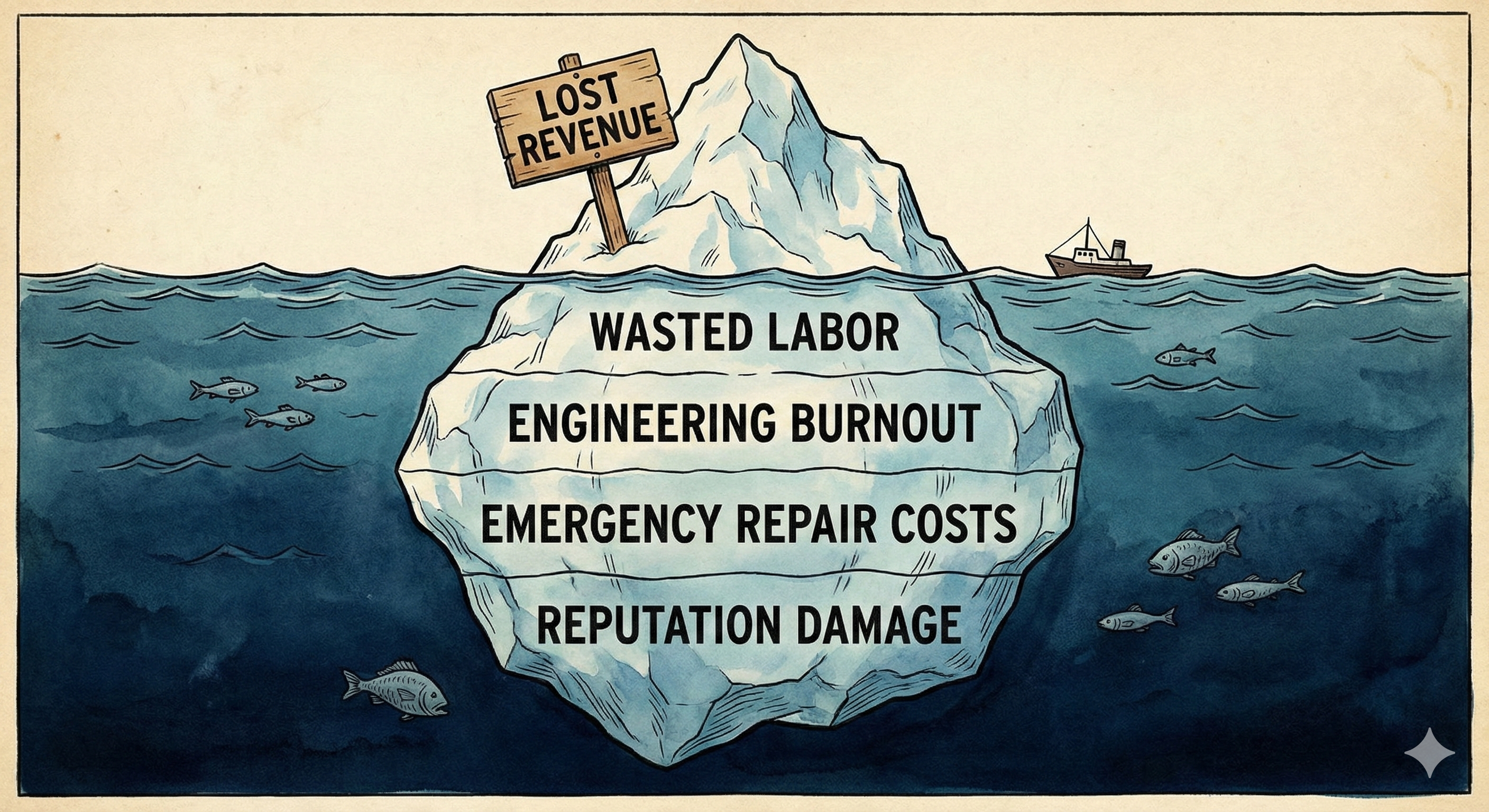
- Wasted Labor Productivity: Humans work explicitly with robots. When the robots stop, the humans stop. You are paying full wages for skilled staff to stand around and wait for a reboot.
- Inflated Mean Time To Repair (MTTR): The average industrial robot repair can take 3-6 hours. Crucially, most of this isn't fixing—it's finding. Engineers spend hours sifting through a "mess of logs" scattered across different SSH sessions just to locate the error.
- The "Opportunity Cost" of Engineering: Every hour your best robotics engineers spend firefighting a production issue is an hour they aren't building the next feature. This stalls innovation and allows competitors to pull ahead.
- Reputational Damage: In a "Just-in-Time" world, reliability is currency. If your robots cause a shipment to miss a cutoff, your customer doesn't blame the robot; they blame you.
Calculating Your "True Cost of Downtime" (TCD)
To prioritize reliability, you need to quantify the pain.
The Formula
Let's break down a real example:
💰 Real-World Example: Mid-Sized Fulfillment Center
Scenario: A 3-hour fleet-wide slowdown
Lost Revenue 3,000 unfulfilled orders × $5 margin = $15,000
Lost Productivity 20 idle warehouse staff @ $25/hr × 3 hours = $1,500
Recovery Costs 2 senior engineers diverted from R&D @ $100/hr × 3 hours = $600
🔴 Total Impact: $17,100
For just ONE afternoon.
At one incident per month, you're bleeding $205,200 annually in pure waste.
From Firefighting to Control: The Observability Imperative
The traditional approach to this problem is "Reactive Firefighting": wait for the alarm, panic, scramble, fix. This status quo is unsustainable.
The alternative is a strategic shift to Proactive Observability.
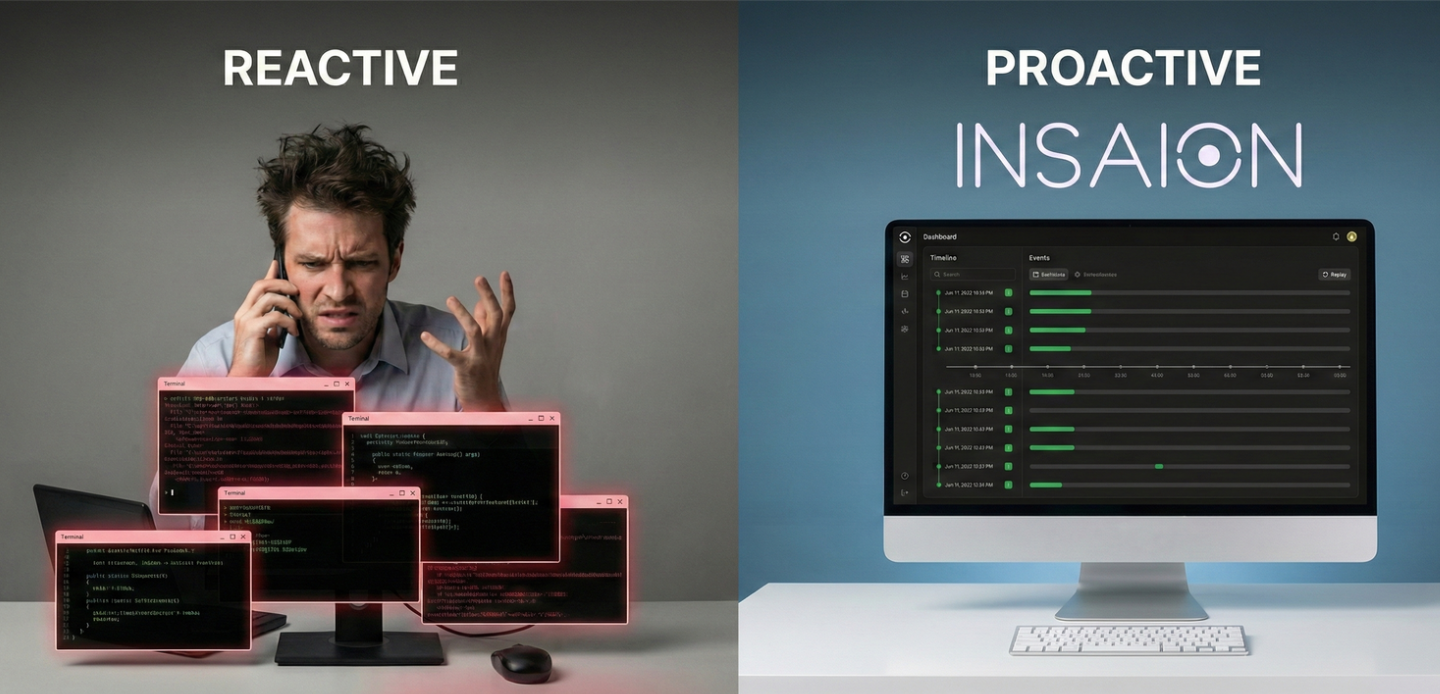
Modern observability platforms like INSAION don't just log errors; they provide a "Black Box" for your entire fleet.
1. Centralized Truth: Instead of SSH-ing into 10 different robots, you have one dashboard showing the health of the entire swarm.
2. Context, Not Just Logs: When a robot fails, you don't just want the error message. You want the CPU load from 5 minutes ago, the battery voltage, the network latency, and the camera feed—all synced on one timeline.
3. The Time Machine: With features like Device Recordings, you can go back and replay the incident. You see exactly what the robot saw. You bridge the sim-to-real gap by capturing the "real" failure in high fidelity.
Conclusion: Turning Liability into Leverage
Unplanned downtime is the silent killer of automation ROI. But it doesn't have to be.
By quantifying the true cost of failure and investing in the tools to see it coming, you transform your operations. You move from a state of constant crisis management to one of control. In the race for automation dominance, the winner won't just be the one with the most sophisticated algorithms—it will be the one whose robots actually stay running.
Stop paying the hidden tax of downtime. Discover how INSAION's rolling buffers and fleet-wide observability can turn your data into your best insurance policy.